TLDR
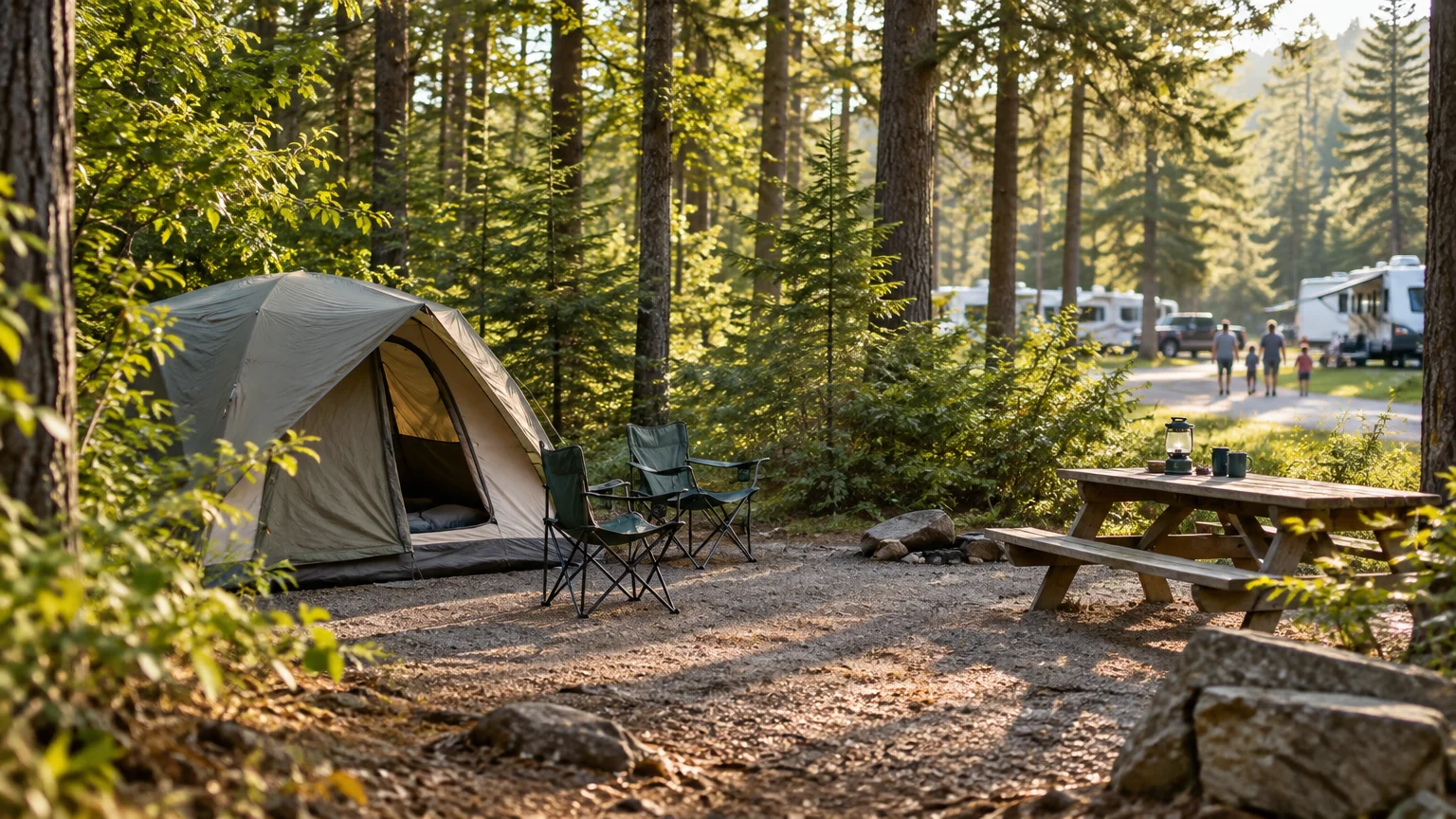
For reliable quiet campsite selection, choose the campground area before choosing the individual site. Prioritize a generator-free, tent-only, walk-in, or otherwise low-traffic loop. Then use the map to avoid main roads, restrooms, playgrounds, group sites, stores, dump stations, boat launches, trailheads, and turnaround points. Confirm the current quiet-hour and generator rules before paying. No site is guaranteed to be silent, but this process removes many predictable sources of noise.
The quietest-looking corner of a campground map is not always the quietest place on the ground. A wooded perimeter site might back onto a highway. A waterfront site might face an early-morning boat launch. An end-of-loop site might get little passing traffic but plenty of vehicles turning around. Good quiet campsite selection means reading the entire campground as a working place, not simply picking the site with the most trees around its symbol.
Choose the right loop before the right site
Start with campground-wide conditions. A large destination campground with a pool, event schedule, marina, and busy playground will have a different sound pattern from a small campground built around hiking and basic camping. Neither is inherently better. The important question is whether the campground and loop match the trip you want.
Look for generator-free loops, tent-only areas, walk-in sites, small loops, and sections separated from major amenities. These designations offer more useful evidence than labels such as “secluded” or “wooded.” Mount Rainier National Park, for example, identifies generator-free loops intended to provide an experience without generator noise. Its official campground information also shows why checking the rules for the actual destination matters.
Generator-free does not mean noise-free. You may still hear children, dogs, doors, tent zippers, traffic outside the campground, or maintenance work. It does remove one common mechanical noise source, however. Tent-only loops can also be calmer, but popular trail access, closely spaced pads, or large groups may offset that advantage.
Never assume that quiet hours and generator policies are universal. Zion National Park states quiet hours of 10 p.m. to 8 a.m. and applies them to people, pets, radios, and generators, while generator rules vary among its campgrounds. Zion’s camping regulations are one example of the detail an official page may provide. Sequoia and Kings Canyon National Parks likewise publish campground-specific regulations rather than one rule that campers can safely apply everywhere.
Read the campground map as a noise map
Once you find a suitable loop, stop looking only at site numbers. Trace how guests, vehicles, staff, and equipment move through the campground. A facility that seems convenient during the afternoon may generate doors, conversations, headlights, carts, and foot traffic after your family has gone to bed.
- Entrance and registration area: expect arriving vehicles, idling, directions, and headlights, particularly around check-in time.
- Main internal road: sites on the primary route receive more passing traffic than sites on a short side loop.
- Restrooms and showers: convenient for families and tent campers, but they attract repeated foot traffic and closing doors.
- Playgrounds, pools, and recreation fields: useful for families, although activity often continues into the evening where rules allow.
- Camp store, firewood station, and gathering area: expect short vehicle stops and conversations.
- Dump station and water-fill point: RV movement and waiting vehicles can make nearby sites busy, especially around checkout time.
- Group camping area: activity depends on the group, but more people generally means more movement and conversation.
- Boat launch or waterfront access: trailers, anglers, paddlers, and early departures can disturb an otherwise scenic site.
- Trailhead: morning hikers and day visitors may arrive earlier than campground activity begins.
- Host or maintenance area: helpful when assistance is needed, but it may also bring radios, service vehicles, and operational activity.
Also inspect what lies beyond the campground boundary. Satellite imagery and the broader park map may reveal highways, rail lines, parking lots, sports fields, beaches, or popular trails that the reservation map does not emphasize. Recent camper reviews can help identify recurring noise, but give more weight to repeated, specific observations than to a single complaint. Conditions and neighbors change; roads and fixed facilities usually do not.
Compare the quieter choice with its tradeoff
| Decision factor | Often the quieter choice | Tradeoff or question to check |
|---|---|---|
| Loop type | Generator-free, tent-only, walk-in, or small side loop | Confirm vehicle access, equipment rules, and walking distance. |
| Road position | Site on a lightly used spur rather than the main campground road | Make sure the spur is not a turnaround or service route. |
| Facilities | Several sites away from restrooms, showers, playgrounds, and stores | Do not create an impractical walk for children or campers with mobility needs. |
| Site orientation | Living area facing away from the road and neighboring gathering spaces | The reservation map may not show the actual pad or fire-ring orientation. |
| Campground edge | Perimeter site with no public attraction behind it | Check for highways, trails, parking areas, and boat access outside the boundary. |
| Waterfront position | Site away from launches, docks, beaches, and fishing access | Water carries sound, and waterfront activity may start early. |
| Trip timing | Weeknight or shoulder-season stay when services are operating normally | Confirm weather, closures, reduced services, and local event dates. |
| Campsite type | Walk-in site where carrying gear is manageable | Extra distance is a poor bargain if it makes setup difficult or unsafe. |
Visual privacy and acoustic privacy are different. Shrubs can hide a neighboring picnic table without blocking conversation. Dense trees can make a site feel secluded while sound travels along water or through an open understory. Treat vegetation as a comfort feature, not proof that the site will be quiet.
Are end-of-loop and waterfront sites quieter?
Sometimes. An end-of-loop site can avoid through traffic, especially when the road terminates in a small camping spur. It can also sit beside a turnaround where drivers reverse, idle, or correct wrong turns. Check the road shape and look for access to trails, service areas, or overflow parking before treating the last site as the best site.
Waterfront camping has the same kind of tradeoff. A site facing an undeveloped shoreline may be peaceful, while a site beside a beach, dock, or launch may wake early. Sound can travel clearly across open water, so activity on the opposite bank may matter too. If you do choose the shoreline, prepare for its practical demands as well as its atmosphere; this waterfront RV camping packing guide covers gear and organization considerations.
Match the quiet site to how you actually camp
A quiet site is only a good reservation if it safely accommodates your people and equipment. Do not trade essential fit, accessibility, or manageable setup for a slightly better map position.
Tent campers
Look for distance from headlights, RV engines, restroom doors, and dishwashing stations. Confirm whether the tent pad fits your shelter and whether you must carry equipment from a parking area. A walk-in site can reduce vehicle noise, but only if the carry is reasonable for your group.
RV campers
Confirm site length, width, surface, hookup position, approach, slide clearance, and any vehicle restrictions before comparing noise. A peaceful back-in site is not useful if the trailer cannot enter without a difficult maneuver or the tow vehicle blocks the road. For broader arrival and setup preparation, review these travel trailer tips for a lower-stress camping trip.
Families
The farthest site from every facility is not automatically the best family site. A reasonable walk to the restroom can prevent stressful nighttime trips, while a position several sites away may reduce door noise and foot traffic. Families using the playground may prefer to be near it without being directly beside it. More ideas for balancing comfort and campground routines are available in these practical tips for camping with kids.
Campers with pets
Avoid sites beside dog-walking routes, dumpsters, wildlife corridors, and heavily used paths when possible. A visually screened site may help some dogs settle, but no map can predict every trigger. Check leash, pet, and unattended-animal rules, and plan how you will reduce barking rather than relying on distance alone.
Use a simple quiet-site scorecard
When several acceptable sites remain, give each one a point for every favorable condition below. This is a comparison tool, not a guarantee. Site fit and safety remain non-negotiable.
- Located in a generator-free, tent-only, walk-in, or low-traffic loop.
- Not on the main entrance or campground circulation road.
- At least a few sites away from restrooms, showers, playgrounds, stores, and group areas.
- Not beside a dump station, water-fill point, boat launch, trailhead, or turnaround.
- No obvious highway, parking lot, event space, or public attraction behind the site.
- Sleeping and gathering areas appear oriented away from traffic and close neighbors.
- Site dimensions, access, hookups, and surface suit your equipment.
- Restroom distance and walking route work for everyone in the group.
- Current reviews do not show a repeated, specific warning about a fixed noise source.
- Official rules and alerts do not identify construction, closures, or operational changes that affect the area.
If two sites score similarly, choose the one with the more predictable surroundings. A restroom is a known source of traffic; an undeveloped boundary usually involves fewer scheduled movements. If only a few sites remain, first eliminate those that do not fit your equipment. From the suitable choices, avoid the biggest fixed noise source rather than chasing a perfect site that is no longer available.
Confirm the details shortly before arrival
Review the official campground page, reservation listing, alerts, and current map before leaving. Check quiet hours, generator hours, fire restrictions, road work, restroom closures, construction, seasonal services, and special events. The U.S. Forest Service also asks campers to observe quiet hours and remain considerate of other visitors, a useful baseline even though the venue’s own rules control.
Contact the campground when an important question is not answered online. Ask specific questions such as, “Does Site 28 back onto the boat-launch road?” or “Is Loop B generator-free?” Staff can answer a concrete question more easily than “Which site is quiet?” Noise tolerance is personal, and they cannot predict who will occupy the next site.
If the assigned site turns out to be noisy, first determine whether the problem is temporary, such as a check-in rush. For an ongoing issue, politely ask staff whether another suitable site is available. Report clear rule violations to campground staff rather than confronting neighboring campers. Earplugs, a fan, or steady low-volume sound can help with ordinary campground noise, but they are not substitutes for following venue rules.
The practical booking rule
When two sites both fit your equipment and group, reserve the one in the lower-traffic or generator-free area that is not directly beside a facility, main road, launch, or gathering place. Then verify the current site-specific rules before paying.
That approach will not promise silence, because weather, wildlife, maintenance, and neighboring campers remain unpredictable. It will give you something more useful: a campsite chosen around the noise sources you can identify and avoid before the trip begins.