TLDR
R-value measures how strongly a sleeping pad resists heat moving through it; a higher number means more insulation between you and the ground. For sleeping pad R value camping decisions, treat R 2 as a warm-weather starting point, R 3 to 4 as a practical three-season range, R 4 to 5.5 for colder or near-freezing nights, and R 5.5 or higher for winter conditions. These are planning ranges, not guaranteed temperature ratings. Check the overnight low, consider whether you sleep cold, and add a foam pad or choose a warmer pad when conditions are close to your setup’s limit.
A warm sleeping bag cannot completely compensate for an under-insulated pad. Your pad, bag or quilt, clothing, shelter, ground conditions, and personal cold tolerance work as one sleep system. If you are deciding between two pad categories for a chilly trip, the warmer option usually provides a more forgiving margin.
Sleeping pad R value camping ranges at a glance
R-value describes resistance to heat flow rather than softness or thickness. Higher values indicate better insulation from the ground. Published guidance broadly places pads below R 2 in warm conditions, R 2 to 3.9 across many three-season conditions, R 4 to 5.4 in colder conditions, and R 5.5 or higher for winter use.
The table below turns those broad categories into conservative trip-planning starting points. It is not a universal temperature conversion. Use the forecast low—not the pleasant afternoon high—and leave extra margin for children, cold sleepers, early-spring ground, damp campsites, and trips where getting cold would be difficult to fix.
| Expected overnight low | Practical starting range | When to add more margin |
|---|---|---|
| Above 50°F | Around R 2 or higher | You sleep cold, use a lightly insulated quilt, or expect cool, damp ground |
| About 32–50°F | Around R 3 to 4 | The forecast is near the bottom of the range, the trip is in early spring, or comfort matters more than packed weight |
| About 20–32°F | Around R 4 to 5.5 | You are camping near freezing, sleeping on snow or very cold ground, or bringing children |
| About 0–20°F | R 5.5 or higher | Conditions are remote, windy, snowy, or colder than your previous experience |
Around 40°F, an ASTM-tested R 3 pad may be workable as part of a suitable three-season sleep system, but R 4 gives a more comfortable planning margin for many tent campers. Near freezing, start looking in the R 4 to 5.5 range rather than expecting a lightly insulated summer pad to do the job.
Why the ground can make you cold
A sleeping bag or quilt insulates by holding warm air within its loft. The insulation beneath your body is compressed by your weight, so it cannot provide the same loft it provides above and around you. The pad supplies much of the insulation on the underside of the sleep system.
That is why adding a warmer bag does not always solve a cold-back problem. If your shoulders, hips, or entire underside feel chilled while the top of your body feels reasonably warm, the pad deserves attention.
Ground temperature can also lag behind air temperature, particularly in spring. Two nights with similar air temperatures may therefore feel different from below. A sunny 60°F afternoon does not tell you how cold the campsite surface will feel at 3 a.m.
What an ASTM-tested R-value tells you
ASTM F3340 is a standardized laboratory method for measuring the thermal resistance of camping mattresses with guarded hot-plate equipment. The ASTM F3340 test-method page describes the formal method used for this comparison.
The practical benefit is comparability. When two pads report values measured under the same standard, their R-values provide a more useful basis for comparing insulation than vague labels such as “warm” or “four-season.”
An ASTM value is still not a promise that every camper will remain comfortable at a particular temperature. Laboratory testing does not reproduce every real-world source of heat loss, including exposed pad surfaces, edge losses, changes in sleeping position, moisture, and how the complete sleep system is arranged.
Be cautious with an older or unlabeled pad. A legacy R-value, estimated value, or marketing description may not be directly comparable with an ASTM-tested number. If you cannot confirm the rating, test the pad in mild conditions and carry a known insulating layer before relying on it for a cold night.
Check the complete sleep system before leaving
Pad insulation is only one part of the decision. Sleeping-bag and quilt labels also need careful reading because products may present comfort, limit, or other temperature information differently. ISO 23537-1:2022 covers thermal and related requirements for certain sleeping bags designed for limit temperatures of -20°C and higher, but not every sleep product or label is interchangeable.
Use this quick check for each trip:
- Find the forecast overnight low for the campground, not just the nearest city’s daytime forecast.
- Locate the pad’s stated R-value and check whether the manufacturer identifies ASTM F3340 testing.
- Read the sleeping bag or quilt label carefully. Do not assume every temperature number means personal comfort at that temperature.
- Add margin if you normally sleep cold, are new to chilly-weather camping, or expect damp or unusually cold ground.
- Give children their own suitable insulation. Do not assume sharing a tent makes an under-insulated child’s pad warm enough.
- Bring a backup layer when the forecast approaches freezing or could change significantly.
- Test the inflated pad and the complete sleeping setup at home before departure.
For a family trip, assign pads by insulation rather than letting everyone choose by color or thickness. Give the warmer pad to the cold sleeper or child, and pack a simple closed-cell foam pad as a backup. More preparation ideas are available in these practical tips for camping with kids.
Layering pads for more insulation
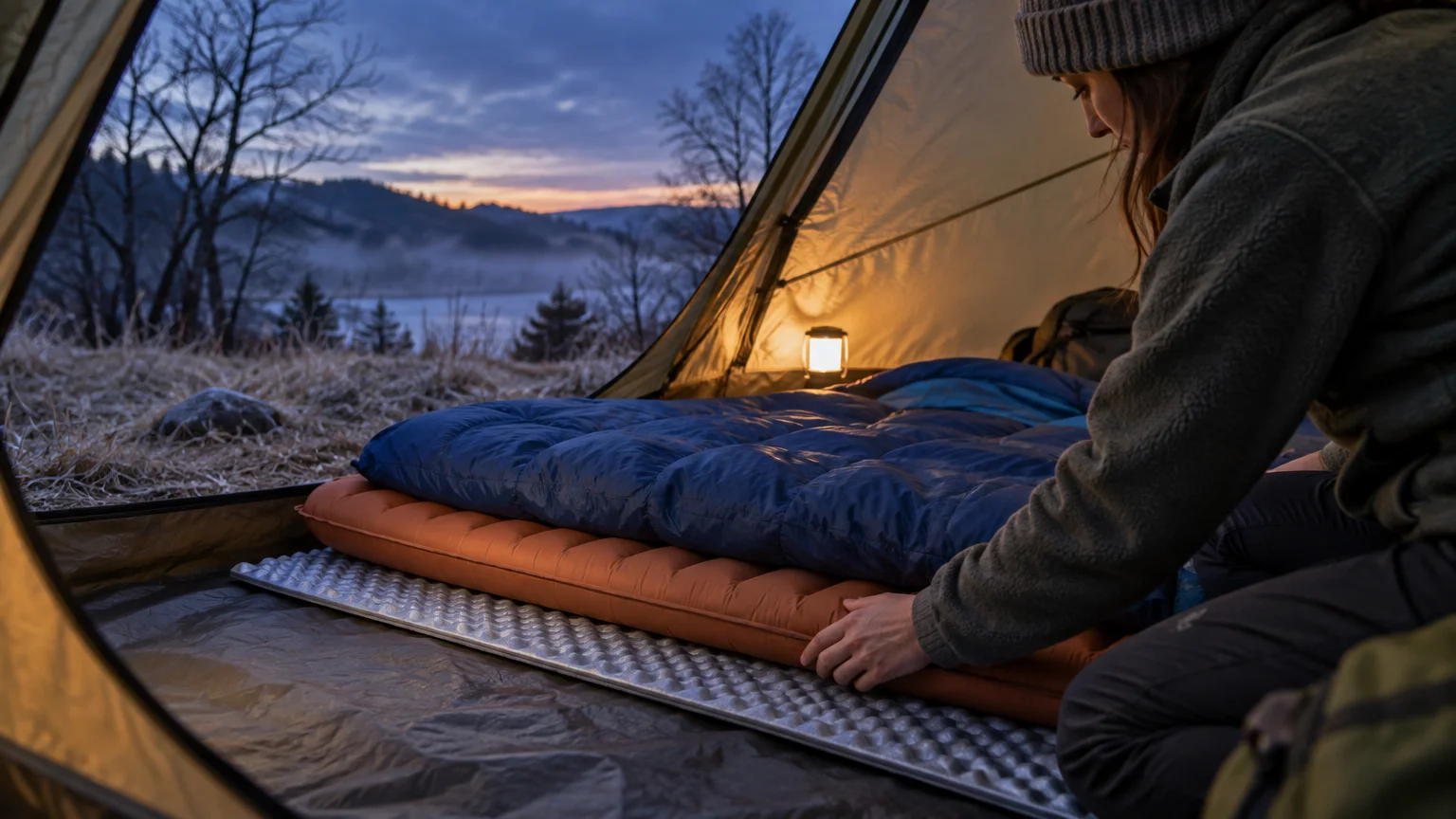
ASTM-tested pad R-values can be added for planning purposes. For example, an ASTM R 2 foam pad paired with an ASTM R 3 air pad provides a combined planning value of R 5. That can extend the usefulness of an existing air pad without requiring an immediate replacement.
A foam layer also remains usable if an inflatable pad develops a leak. It may not be comfortable enough by itself for every sleeper, but it can preserve some ground insulation while you repair the air pad or adjust the night’s arrangements.
Do not rely on arithmetic alone. Make sure the layered pads remain stable, fit inside the tent, and are wide enough to stay beneath your shoulders and hips. Test the combination at home so you know whether it slides, squeaks, or raises you too close to the tent wall.
Warmth, thickness, and comfort are different measurements
A thick pad is not automatically a warm pad. Thickness affects cushioning and how far your hips or shoulders stay above the ground, while R-value addresses thermal resistance. Internal insulation and construction matter, so compare the stated tested R-value rather than judging warmth by height alone.
After meeting your insulation requirement, compare the features that affect whether you will enjoy using the pad:
- Thickness and support for side sleepers or campers with sensitive hips
- Width and shape, especially for active sleepers
- Packed size and weight for the distance between the vehicle and campsite
- Inflation and deflation effort
- Noise when changing position
- Fabric durability and puncture resistance
- Valve design and field-repair options
- Whether the pad fits the tent alongside everyone else’s gear
Car campers can usually accept more weight and bulk to gain insulation, width, or durability. Backpackers face a tighter balance among warmth, weight, packed size, and reliability. In either case, buy enough insulation first; an impressively light pad is not a bargain if it leaves you awake and cold.
Common sleeping-pad R-value questions
Is R 3 enough for camping around 40°F?
It can be, particularly for a warm sleeper using a suitable sleeping bag on moderate ground. However, R 4 provides more margin if you sleep cold, expect damp or early-spring conditions, or are uncertain about your bag. Treat 40°F as a system decision rather than a pass-or-fail pad temperature.
What R-value should I consider near freezing?
Around freezing, R 4 to 5.5 is a sensible starting range. Move toward the warmer end for children, cold sleepers, snow, cold spring ground, or forecasts that may fall below 32°F.
Can I place a foam pad under an air pad?
Yes. Layering a foam pad with an ASTM-rated air pad can increase the combined insulation, and the values can be added for planning. There is no need to assume one universal stacking order; use the arrangement that is stable, protects the inflatable pad, and works with the manufacturers’ instructions.
Should children use a higher R-value?
A warmer pad is a prudent choice when you do not yet know a child’s cold tolerance. Children may not describe a developing comfort problem clearly in the middle of the night, so provide margin, dry sleep clothing, and an adult-tested setup instead of choosing the minimum plausible rating.
Make the choice before the cold night
Check the campground’s expected overnight low, find the pad’s tested R-value, and compare it with the complete sleep system. For warm summer nights, around R 2 may be adequate. For broad three-season use, R 3 to 4 is more versatile. When the forecast approaches freezing, move into roughly the R 4 to 5.5 range or add a rated foam layer. For winter conditions, begin at R 5.5 or higher and plan with wider safety and comfort margins.
If you are close to a range boundary, choose more insulation rather than relying on the forecast to remain perfect. Test the pad for leaks, pack a repair kit, and try the full setup at home. Those small steps are far easier than rebuilding a sleep system after the ground has already pulled the warmth out of your night.
References
- Sleeping Pad Buying Guide: Types, R-Value & Tips | REI Co-op
- F3340 Standard Test Method for Thermal Resistance of Camping Mattresses Using a Guarded Hot Plate Apparatus
- ISO 23537-1:2022 – Requirements for sleeping bags — Part 1: Thermal, mass and dimensional requirements for sleeping bags designed for limit temperatures of ‐20°C and higher